Collection 01
YOUR FAITH HAS SAVED YOU
"Then He said to the woman, 'Your faith has saved you. Go in peace.'"
BIBLICAL INSIGHT
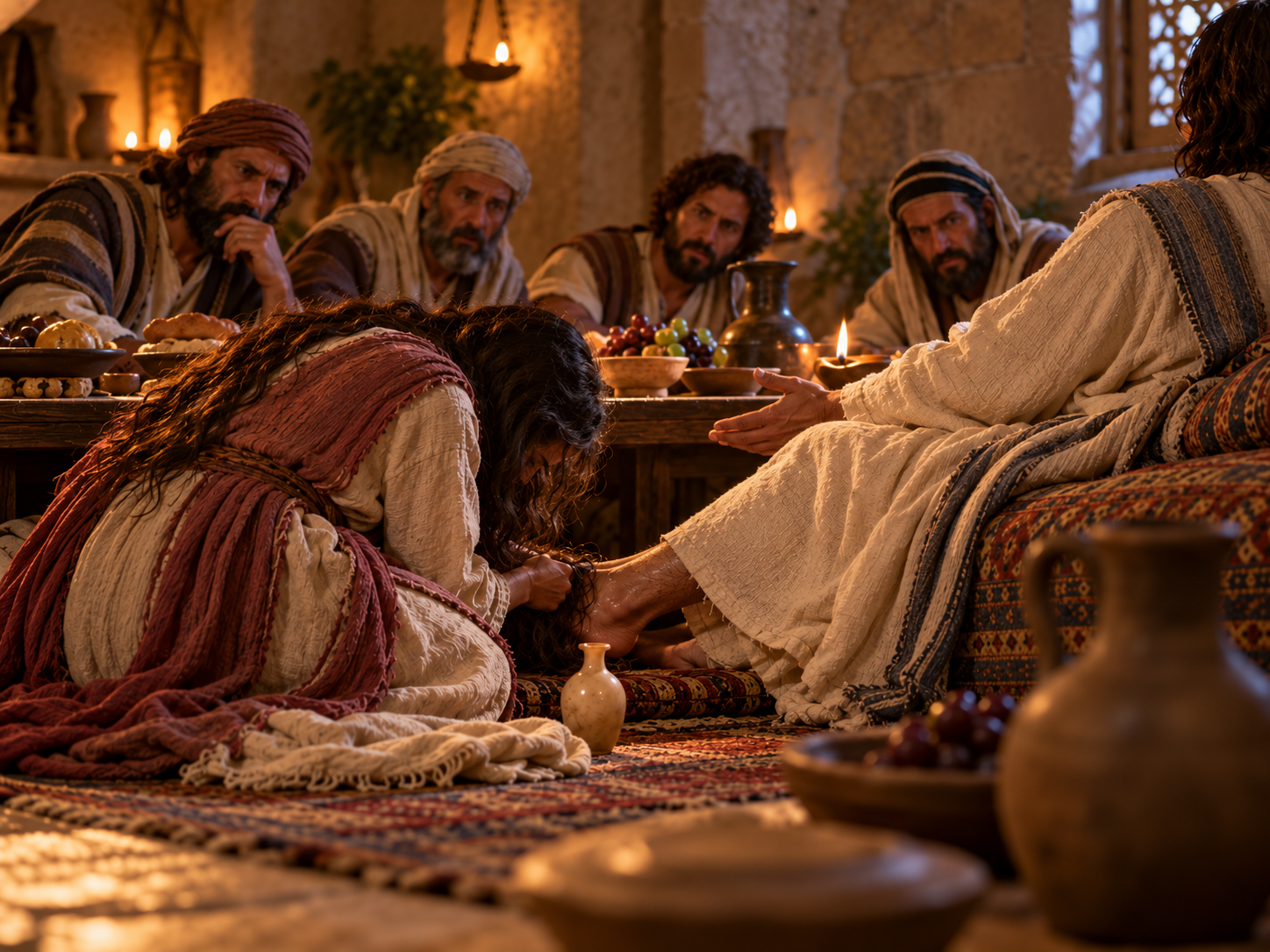
THE LAST WORD WAS PEACE Simon invited Jesus into his home. Then someone else entered. Luke never gives us her name. He simply tells us that she was “a woman in the city who was a sinner.” Whatever she had done, her reputation had become public enough that Simon immediately knew what kind of woman was standing near Jesus. She brought an alabaster flask of fragrant oil and came behind Jesus at His feet. Then she began to weep. Her tears fell heavily enough to wet His feet. She wiped them with her hair, continued kissing them, and anointed them with the perfume she had brought. Luke records no words from her. No defense of her past. No explanation for why she had come. No attempt to convince the room that she had changed. Only tears, affection, humility, and an unmistakable devotion to Christ. Simon watched all of it. But instead of seeing repentance, gratitude, or faith, he saw a category. Sinner. And what troubled Simon was not merely the woman. It was Jesus. “If this Man were a prophet,” Simon reasoned within himself, He would know what kind of woman was touching Him. The irony is immediate. Simon doubts Jesus’ prophetic knowledge because he assumes Jesus does not know the woman. Then Jesus answers the thought Simon never spoke aloud. “Simon, I have something to say to you.” Jesus tells him about two people who owe a creditor money. One owes five hundred denarii. The other owes fifty. The debts are dramatically different. Their problem is exactly the same. Neither can pay. That is the center of the parable. The creditor does not establish a payment plan. He does not reduce the interest. He does not ask either debtor to prove that he deserves relief. He freely cancels both debts. Then Jesus asks Simon which debtor will love the creditor more. Simon answers correctly: “I suppose the one whom he forgave more.” Jesus turns toward the woman. But He continues speaking to Simon. “Do you see this woman?” Simon had been looking at her from the moment she entered. But Jesus’ question exposes the difference between looking at someone and truly seeing them. Simon saw her reputation. Jesus saw the woman. Simon saw contamination. Jesus saw faith. Simon saw someone whose past should keep her away from Jesus. Jesus saw someone who had come to Him because she knew she needed mercy. Then Jesus begins comparing what has happened inside Simon’s own house. Simon gave Him no water for His feet. She washed His feet with tears. Simon offered Him no kiss of greeting. She had not stopped kissing His feet. Simon did not anoint His head with ordinary oil. She anointed His feet with fragrant oil. The woman Simon regarded as unworthy to be in the room had welcomed Jesus with an affection and honor that His host had withheld. Then Jesus says something that must be read carefully: “Her sins, which are many, are forgiven, for she loved much.” Jesus does not pretend her sins were small. Grace does not require Him to rewrite her past. He calls her sins “many.” But neither does He teach that she purchased forgiveness through extravagant love. His own parable has already established the order. The debt is forgiven. Then love follows. The woman’s love is the evidence of mercy received, not the price she paid to receive it. That matters because everything she has done could easily become the focus. She wept. She humbled herself. She served. She gave something valuable. She loved extravagantly. But when Jesus finally tells us what saved her, He does not point to any of those things. He says: “Your faith has saved you.” Not your tears. Not your perfume. Not your public humiliation. Not even your love. Your faith. Her actions mattered because they revealed the heart of someone who had entrusted herself to Christ. The contrast with Simon is therefore deeper than respectable man versus sinful woman. Jesus’ parable contains two debtors. Both owe. Both are unable to pay. Both require the creditor to do for them what they cannot do for themselves. The difference is that one understands the magnitude of mercy and responds with love. The danger in Simon’s position is not necessarily that he has committed fewer sins. It is that he does not appear to understand himself as someone standing in desperate need of forgiveness. The woman does. And because she knows she needs mercy, she comes near to the One who can give it. Jesus then says directly to her: “Your sins are forgiven.” The other guests immediately begin asking: “Who is this who even forgives sins?” It is the same question Luke has already raised earlier in Jesus’ ministry. Who has the authority to forgive sins? But Jesus does not allow their debate to become the final sound this woman hears. He turns back to her. “Your faith has saved you. Go in peace.” Luke introduced her through the reputation the city had given her. A sinner. Jesus sends her away with words He gives her. Forgiven. Saved. Peace. The room knew what she had been. Jesus knew where her faith had been placed. And the final word over her life in this account does not belong to Simon, the guests, her reputation, or even her past. It belongs to Christ. “Go in peace.”
historical context
AT SIMON’S TABLE
The scene takes place during Jesus’ Galilean ministry, although Luke never tells us the name of the city. A Pharisee named Simon invited Jesus to eat with him. That invitation itself is significant. Jesus was willing to sit at the table of a religious leader just as He was willing to eat with people the religious establishment considered sinners. Luke repeatedly presents Jesus moving across the social boundaries other people guarded carefully. Meals in the first-century world did not look like a modern dinner around upright chairs. Guests at formal meals commonly reclined around a low table with their upper bodies toward the food and their feet extending away from the table. That arrangement explains how the woman could approach Jesus from behind and stand at His feet without stepping between Him and the meal. Meals involving a notable teacher could also be less private than a modern dinner inside a closed home. In some settings, outsiders could gather nearby to observe or listen. The woman’s entrance was socially shocking, but her presence does not require us to imagine that she broke through a locked private dining room. Luke tells us why her arrival mattered. She was known in that city as “a sinner.” That is all Scripture tells us about the nature of her past. The text does not identify her as a prostitute. It does not call her Mary Magdalene. And it does not identify her as Mary of Bethany. Those associations developed through later interpretation, but Luke does not make them. In fact, Luke introduces Mary Magdalene separately in the very next chapter, and the anointing at Bethany recorded later in Matthew, Mark, and John occurs in a different place, at a different point in Jesus’ ministry, under different circumstances. This woman should therefore be allowed to remain who Luke presents her to be: an unnamed woman whose sinful reputation was publicly known. She entered carrying an alabaster flask containing fragrant oil. Alabaster containers were commonly associated with valuable perfumes and ointments. Luke does not identify the perfume precisely or tell us its monetary value, so there is no need to assign a specific price to it. What matters in the scene is that she came prepared to honor Jesus with something meaningful. Then her emotions overtook the action. She stood behind Him weeping. Her tears began falling onto His feet. With no towel prepared, she used her own hair to wipe them. That act would have made an already exposed woman even more socially vulnerable. Public expectations concerning respectable female appearance and hair were strong in the ancient Mediterranean world. Yet concern for how the room might judge her appears to have become secondary to what she wanted to express toward Christ. She continued kissing His feet and anointing them with perfume. Simon watched. In the honor-conscious world of the first century, hospitality communicated relationship and regard. Jesus later points out three courtesies Simon had not extended to Him: water for His feet, a kiss of greeting, and oil for His head. Jesus does not merely mention those omissions. He places them beside what the woman has done. Simon provided no water. Her tears became water. Simon gave no kiss. She would not stop kissing His feet. Simon provided no ordinary oil. She brought fragrant perfume. The social reversal inside the room is remarkable. The respected Pharisee is the host of the house. Yet the woman everyone believes does not belong there becomes the one who most fully honors the guest. Then Jesus tells the parable of the two debtors. One owes five hundred denarii and another fifty. A denarius represented roughly a day’s wage for an ordinary laborer, so Jesus intentionally describes debts of very different magnitude. But He gives both men the same decisive problem: “When they had nothing with which to repay...” Neither debtor can settle his account. The creditor freely cancels both debts. Jesus then turns toward the woman while continuing to speak to Simon and asks one of the most penetrating questions in the account: “Do you see this woman?” Simon certainly sees her physically. He has already judged her. The question is whether he can see anything beyond what he knows about her past. The woman never speaks in Luke’s account. Simon speaks. The guests speak. Jesus speaks. But her faith becomes visible through the way she comes to Christ. Jesus finally declares that her sins are forgiven, prompting the other guests to ask who He is that He can forgive sins. That reaction reveals how extraordinary His declaration was. Jesus was not merely telling her that she should stop feeling guilty. He was speaking with authority concerning her standing before God. Then He sends her away: “Your faith has saved you. Go in peace.” She entered Simon’s house carrying a reputation known throughout the city. She left carrying Christ’s declaration of forgiveness.
Estimated Date
c. AD 29–30
Luke does not provide an exact calendar date for this meal. The account belongs to Jesus’ Galilean ministry. Luke places it after Jesus’ teaching recorded in Luke 6, the healing of the centurion’s servant at Capernaum, the raising of the widow’s son at Nain, and John the Baptist’s inquiry about Jesus. It occurs before Luke describes Jesus traveling through the cities and villages proclaiming the kingdom in Luke 8. Consistent with the chronology used throughout this Collection, c. AD 29–30 is the appropriate working estimate. The precise day, month, year, and city remain unknown.
Key Insight
LOVE WAS THE EVIDENCE, NOT THE PRICE
At first reading, Jesus’ words can sound as though the woman was forgiven because she managed to love Him enough: “Her sins, which are many, are forgiven, for she loved much.” But Jesus has already told us how to understand the scene. A creditor had two debtors. One owed much more than the other, but neither possessed the ability to pay. The creditor forgave them first. Then Jesus asked which debtor would love him more. The love came after the debt was canceled. That same order explains the woman. Her tears did not purchase forgiveness. Her perfume did not purchase forgiveness. Humbling herself before the room did not purchase forgiveness. Even her extraordinary love for Jesus did not purchase forgiveness. Her love showed what mercy had done to her. That is why Jesus’ final statement matters so much: “Your faith has saved you.” He does not say, “Your love has saved you.” The woman’s love is not minimized. Jesus publicly honors it. But He places salvation somewhere deeper. Faith receives what grace gives. Then love responds. This also exposes the danger in Simon’s position. The parable does not contain one debtor and one debt-free man. It contains two debtors who are both unable to pay. The difference is not that one needs grace and the other does not. The difference is how clearly each understands the mercy he needs. The person who believes he has little to be forgiven will naturally love little because grace will always appear small to someone who thinks his debt is small. The woman knew she needed mercy. So when she found mercy in Christ, love overflowed. The Christian life does not begin by trying to manufacture enough love to make God forgive us. It begins by seeing that we cannot pay our debt, trusting the One who can forgive it, and allowing the magnitude of His mercy to reshape the way we love Him. Forgiveness does not make love unnecessary. Forgiveness makes love possible.

location
Luke does not identify the city where Jesus ate at the home of Simon the Pharisee. The account occurs within Jesus’ Galilean ministry, after events at Capernaum and Nain and before Luke describes Jesus traveling through the surrounding cities and villages proclaiming the kingdom. Because Scripture does not preserve the precise location of Simon’s house, this map marks Galilee as the broader historical setting rather than assigning the event to an unconfirmed city.
language insight
language
Koine Greek
original
ἐχαρίσατο · ἡ πίστις σου σέσωκέν σε · πορεύου εἰς εἰρήνην
transliteration
echarisato · hē pistis sou sesōken se · poreuou eis eirēnēn
meaning
Freely forgave · your faith has saved you · go into peace
Several Greek expressions help reveal the movement of this passage. In Jesus’ parable, the creditor “freely forgave” both debts. The verb is ἐχαρίσατο (echarisato), from χαρίζομαι (charizomai), a word associated with showing favor, giving freely, or graciously forgiving. The point is not merely that the creditor decided not to collect. The cancellation is an act of generosity toward people who have nothing with which to repay him. That language fits the entire scene. The debtors cannot pay. The creditor gives. Then love follows. When Jesus finally speaks directly to the woman in verse 50, He says: ἡ πίστις σου σέσωκέν σε hē pistis sou sesōken se “Your faith has saved you.” πίστις (pistis) means faith, trust, or reliance. In this context it is more than acknowledging that Jesus exists. The woman has entrusted herself to Him. σέσωκέν (sesōken) comes from σῴζω (sōzō), “to save, rescue, deliver, or make whole.” The verb is in the perfect tense, presenting the saving action as accomplished with a resulting present state. Elsewhere in Luke, this same language can accompany physical healing and restoration. Here the context makes its spiritual force unmistakable. Immediately before verse 50, Jesus has declared: “Your sins are forgiven.” The other guests are questioning His authority to forgive sins. Then Jesus says: “Your faith has saved you.” Luke therefore places salvation, forgiveness, and faith together in the same moment. Jesus finishes with: πορεύου εἰς εἰρήνην poreuou eis eirēnēn The NKJV renders it: “Go in peace.” More literally, the construction can be heard as: “Go into peace.” Peace, εἰρήνη (eirēnē), carries the biblical background of shalom: well-being, wholeness, and peace before God. In ordinary speech this kind of expression could function as a farewell. But after Jesus has just pronounced her sins forgiven and her faith saving, these are not empty social words. The woman who entered the house carrying the burden of a public reputation is sent back into the world under the assurance of Christ. Forgiven. Saved. Into peace.
Sources
- New King James Version, Luke 7:36–50, “A Sinful Woman Forgiven.” Scripture quotation and primary biblical text. The NKJV text is © Thomas Nelson.
- NET Bible, Luke 7:40–50, translation and study notes. Especially relevant to Luke 7:47 and the distinction between the woman’s love as evidence of forgiveness rather than its cause.
- Darrell L. Bock, Luke 1:1–9:50, Baker Exegetical Commentary on the New Testament. Baker Academic, 1994. Especially pp. 703–705 on Luke 7:47.
- Joel B. Green, The Gospel of Luke, New International Commentary on the New Testament. Eerdmans, 1997.
- Craig S. Keener, “Ministry and the Marginalized — Luke 7:36–50.” Bible Background. Cultural background concerning reclining meals, hospitality, the woman’s hair, Simon’s omissions, and Jesus’ welcome of the marginalized.
- R.C. Sproul, “The Forgiven Woman.” Sermon on Luke 7:36–50, Ligonier Ministries, November 11, 2012.
- Charles H. Spurgeon, “Saving Faith.” Metropolitan Tabernacle Pulpit, March 15, 1874. Sermon on Luke 7:50 and Luke 18:42, emphasizing Jesus’ declaration that faith saved the woman.
- Charles H. Spurgeon, “Go in Peace.” Metropolitan Tabernacle Pulpit, September 23, 1883. Sermon on Luke 7:50.
- Charles H. Spurgeon, “A Gracious Dismissal.” Metropolitan Tabernacle Pulpit, January 11, 1891. Sermon on Luke 7:50 and Christ’s words, “Go in peace.”
- John Piper, “Forgiveness Leads to Love.” Look at the Book, Luke 7:36–50, Part 1. Desiring God, September 22, 2015.
- Timothy Keller, “With the Powerless.” Redeemer Presbyterian Church / Gospel in Life, January 26, 1997. Sermon on Luke 7:36–50.
- Blue Letter Bible Greek Lexicon, πίστις (pistis), Strong’s G4102 — faith, trust, belief.
- Blue Letter Bible Greek Lexicon, σῴζω (sōzō), Strong’s G4982 — to save, rescue, deliver, or make whole.
- Blue Letter Bible Greek Lexicon, εἰρήνη (eirēnē), Strong’s G1515 — peace, well-being, harmony.
- Blue Letter Bible Greek Lexicon, χαρίζομαι (charizomai), Strong’s G5483 — to give graciously, show favor, or freely forgive.